📍Home💾
🔭Site 1💾✕
🌌Site 2💾✕
Live solar conditions for
—
🏠 Change
☀️
Is today good for
Is today good for
solar observing?
The serious solar observer's dashboard — Solar Score, active regions, sunspot activity, flare risk, solar wind, geomagnetic forecast, hourly forecast and eclipse tracker for any location.
☀️ Solar Score
⚫ Active Regions
⚡ Flares + History
💨 Solar Wind/Bz
🌌 3-Day Kp
📊 Hourly Forecast
🪐 Daytime Planets
🌑 Eclipses
—
/ 100
Solar Observing Score
—
Loading...
Fetching solar conditions...
⏱ Calculating...
How the Solar Score is calculated:
Cloud cover 35% · Sun altitude 30% · Daytime seeing 20% · Wind 10% · UV index 5%
🌙 View tonight's sky dashboard →
Cloud cover 35% · Sun altitude 30% · Daytime seeing 20% · Wind 10% · UV index 5%
📐
Sun Altitude
—
—
☁️
Cloud Cover
—
—
👁️
Daytime Seeing
—
—
💨
Wind
—
—
Safe Solar Observing Window & Best Time Today
Green = sun above 20° altitude · Gold = optimal mid-morning seeing window
—
Sunrise
—
Peak Altitude
—
Max Altitude
—
Sunset
≈ sea-level horizon · true-north bearings — why?
Local terrain — hills, trees, buildings — can shift the actual sunrise/sunset by a few minutes. Bearings are geographic true north: set your phone compass to True North so its reading matches (iPhone: Settings › Compass › Use True North · Android: enable true north in your compass app).
💡
Best observing window: typically mid-morning before ground heat creates atmospheric turbulence. Calculating optimal time...
Hour by Hour — Daytime Forecast
Sunrise through sunset — full day sky conditions
Clear
Good
Cloudy
Poor
Rain
📊Loading forecast...
☀️
Today's Solar Highlights
Loading current solar conditions...
⚫
Solar Activity
Sunspot Number (SSN)
—
Fetching NOAA data...
—
F10.7 Flux
SC25
Solar Cycle
☀️Calculating activity level...
⚡
X-ray Flux & Flare History
—
CURRENT
Loading flare data...
Last 24 Hours
24h agonow
🌡️
UV Index & Comfort
—
—
Observer Protection
Calculating...
Conditions Valid As Of
—
🎯
Today's Active Regions — What to Point At
The most prominent active regions on the visible disc right now, ranked by area and flare potential. NOAA-classified magnetic complexity. Use these to plan your H-alpha or white light session.
Loading active region data from NOAA...
Magnetic class: α=simple · β=bipolar · γ=complex · δ=most complex (highest flare risk)
💨
Solar Wind & Bz — Live
—
KM/SEC
—
Bz · nT
Loading...
Fetching DSCOVR data...
Bz southward (negative) = aurora friendly · Bz northward (positive) = CMEs deflected
🌌
3-Day Geomagnetic Forecast
—
—
—
—
—
—
—
—
—
Maximum predicted Kp index from NOAA SWPC. Confidence drops past 24h — beyond a day out, treat as a rough estimate, not a commitment.
🌠 Tonight's aurora forecast →
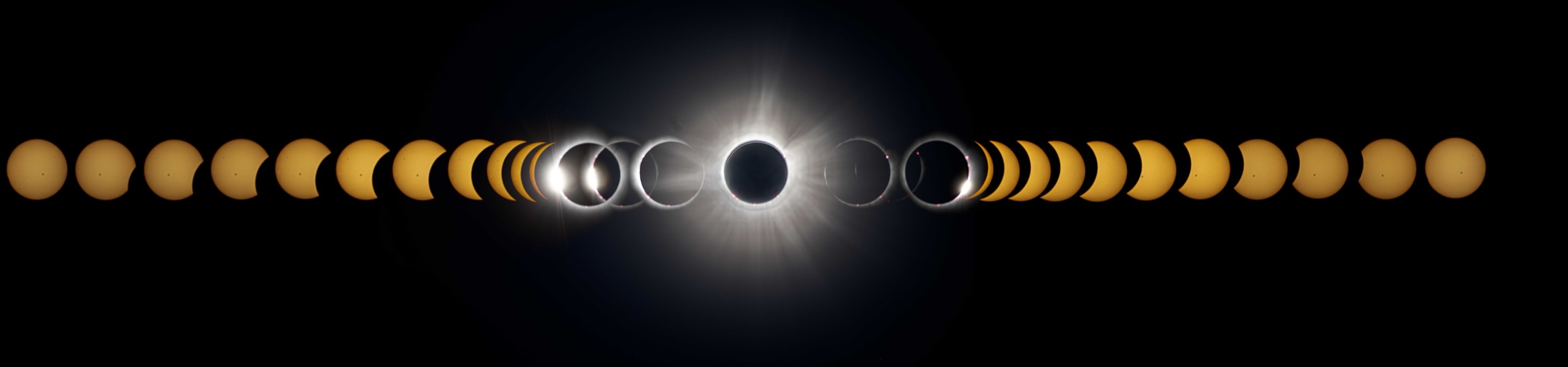
Total Solar Eclipse · April 8 2024 · St-Gédéon-de-Beauce, Quebec · Photo by Tim Mullin →
🌑
Eclipse Tracker — Next Solar & Lunar Events
Eclipse data based on NASA Eclipse Catalog. Always verify exact path of totality and conditions before any travel.
🪐
Daytime Planet Visibility
Bright planets occasionally visible in daylight under exceptional conditions. Venus is most achievable; Jupiter rarely; Mercury never (too close to Sun — dangerous).
⚠️ Never sweep the sky with binoculars or scope while the Sun is up unless you have proper solar filtration — you can swing through the Sun by accident.
📷
Live Solar Imagery — From Space & Ground
Real-time and recent images from professional solar observatories. Tap through for the current view of the Sun.
⚠️
One more time: Never look at the Sun through any optical instrument without a properly mounted, certified front-aperture solar filter. ND filters, exposed film, sunglasses and welder's glass below shade 14 are NOT safe. When in doubt, don't. Your eyesight is irreplaceable. Solar terms glossary →
🌌
Now Check Tonight's Sky
Solar covers the day — head to the night dashboard for tonight's stargazing forecast.
View Tonight's Sky →